
By Luisa Freitas and Abiodun Salako
Hazardous chemical pollution and wildlife trafficking are rarely discussed together. Nevertheless, GEF-9 builds both of its next Integrated Programmes, Pollution-free Supply Chains and Global Wildlife for Development, on the same premise: neither problem can be solved by any one country acting alone. Hazardous chemicals such as persistent organic pollutants (POPs), endocrine disruptors and heavy metals travel across regions, carried by wind, water and international trade long after they leave a factory floor. Illegal wildlife trade travels just as far, estimated at USD 23 billion a year, a scale rivalled only by narcotics, human trafficking and counterfeit goods. Habitat fragmentation compounds the pressure, with roads and railways cutting through wildlife landscapes, now a significant driver of wildlife mortality and lost migratory connectivity. This follows our earlier piece on Drylands and Drought Management and Food Systems, looking at what these two IPs aim to achieve and where E Co’s experience can support countries and partners developing projects in either area.
Pollution-free supply chains
Global supply chains span agriculture, construction, textiles, electronics and manufacturing, and though central to global commerce, they are a major contributor to environmental degradation, greenhouse gas emissions and biodiversity loss. Hazardous chemicals such as persistent organic pollutants, endocrine disruptors and heavy metals travel across regions through wind, water and international trade once they enter a supply chain, so pollution generated in one country’s factories can settle far from where it began.
Pollution-free Supply Chains continues the work on the GEF-8 Integrated Programme on Eliminating Hazardous Chemicals from Supply Chains, which moved across construction and fashion, and widens that foundation to textiles, electronics, critical minerals, agriculture and agro-processing, construction and shipping. Plastics are handled separately under GEF-9’s own Circular Solutions to Plastics Pollution IP, so this programme leaves that category to its counterpart.
The GEF-8 experience showed that confronting these problems demands strong governance, blended finance, stakeholder engagement and technological innovation working together, rather than any single lever on its own. GEF-9 puts that approach through three areas. The programme will support the phase-out of hazardous chemicals, including POPs, heavy metals and PFAS; encourage renewable energy and lower-carbon logistics; and support the restoration of ecosystems affected by sourcing and production, including through deforestation- free supply commitments.
For this IP, lasting change across these supply chains hinges on deploying four levers together, not any one alone, set out below.
| Lever | Description |
|---|---|
| Blended finance | De-risk safer alternatives. |
| Private sector engagement | Supply chain audits and shared industry standards. |
| Policy coherence and governance | Alignment across chemicals, emissions and biodiversity regulation, echoed in due diligence laws such as the EU Deforestation Regulation and Germany’s Supply Chain Act. |
| Whole of society participation | Clear role for workers and communities, including informal waste pickers, whose livelihoods depend on these industries today. |
Source: GEF Secretariat, GEF-9 Programming Directions (GEF/R.9/12)
The programme aligns with the Stockholm Convention on persistent organic pollutants, the Minamata Convention on mercury, the Basel Convention on hazardous waste and the Paris Agreement, and contributes to Target 7 on reducing pollution and Target 15 on business responsibility under the Kunming-Montreal Global Biodiversity Framework.
Global wildlife for development
Global wildlife populations have fallen by 73 per cent over the past fifty years, driven mainly by habitat loss and fragmentation on one side and unsustainable, and often illegal, exploitation and trade on the other (WWF, 2024). Human-wildlife conflict is intensifying too. In a global survey by the Global Wildlife Program, nearly two-thirds of governments described it as a major and serious issue, and most said the problem is getting worse. Wildlife-based tourism, meanwhile, generates an estimated USD 120.1 billion a year and supports 21.8 million jobs, a reminder of how much is at stake economically as well as ecologically (World Travel & Tourism Council, 2018). Global Wildlife for Development draws on ten years of the Global Wildlife Programme across GEF-6, GEF-7 and GEF-8, with that work moving ahead through four components.
| Component / Action Area | Description |
|---|---|
| Wildlife landscapes | Maintain ecologically connected wildlife landscapes across protected areas and Indigenous and traditional territories |
| Illegal trade | Tackle illegal and unsustainable wildlife trade along domestic and international supply chains, covering anti-poaching, law enforcement, disrupting trafficking networks, and reducing consumer demand. |
| Human-wildlife conflict | Prevent and reduce human-wildlife conflict through community-based measures, analog and digital alert systems, and wildlife damage insurance. |
| Economic opportunities | Diversify economic opportunities, from nature-based tourism to wildlife-friendly enterprise, that give local communities a stake in conservation rather than exploitation. |
Source: GEF Secretariat, GEF-9 Programming Directions (GEF/R.9/12)
The GEF-9 IP also invests directly in the people doing this work on the ground, building the capacity and welfare of wildlife rangers, who it treats as planetary health workers central to meeting the 30×30 target, the global target to protect 30 per cent of land and sea by 2030. The programme leans heavily on technology, drones and satellite imagery to track wildlife movements and habitat threats, blockchain to trace wildlife products through supply chains, and artificial intelligence to analyse population data, alongside transboundary cooperation between countries that share migratory species and enforcement challenges. It is anchored mainly in the Biodiversity Focal Area, with contributions to Land Degradation through habitat restoration and Climate Change through the emissions avoided by conserving intact habitat, and it contributes directly to Targets 1, 2, 3, 4, 5 and 9 of the Kunming-Montreal Global Biodiversity Framework.
E Co’s track record across pollution and industrial waste
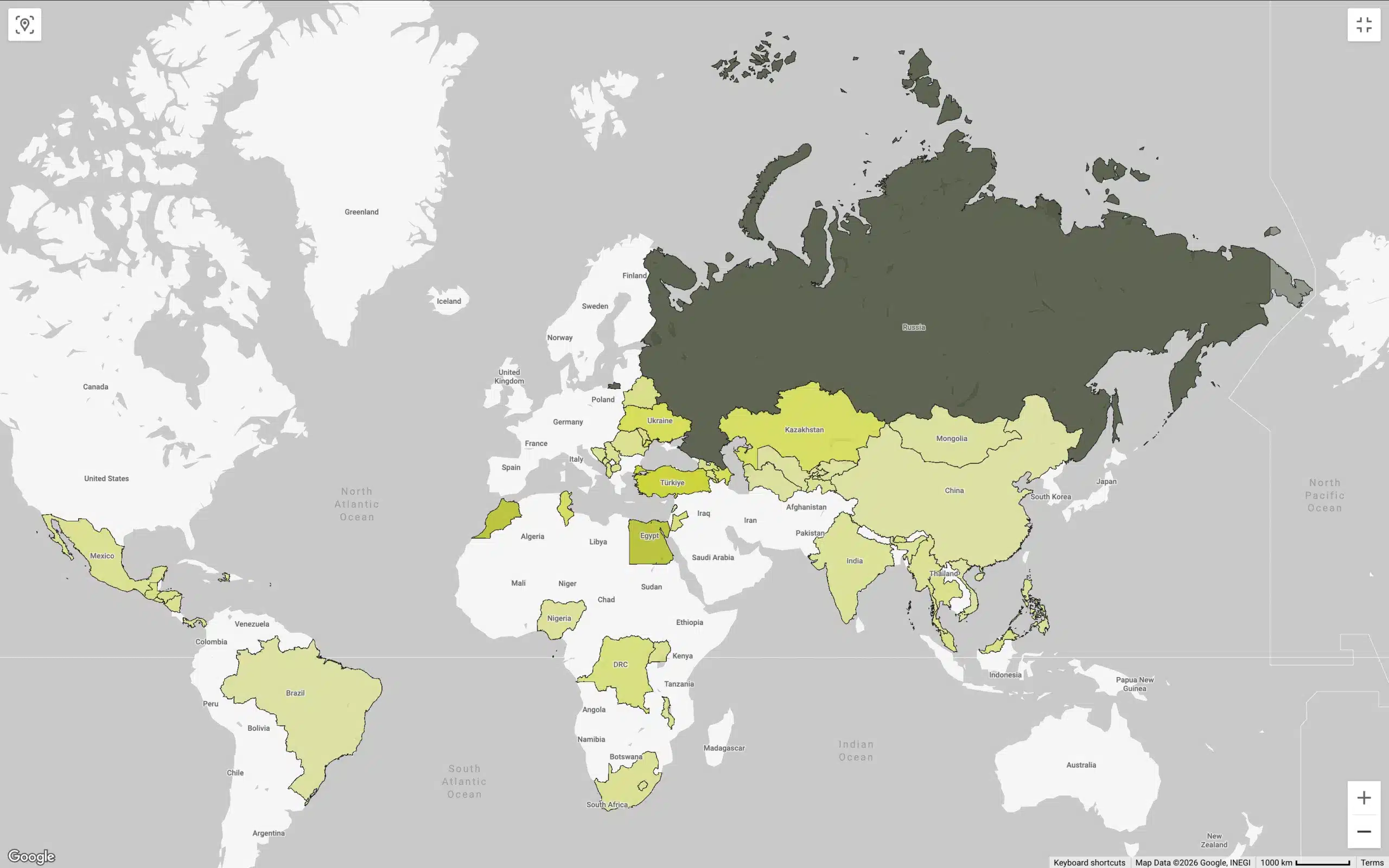
E Co’s pollution and industrial waste experience runs across three continents. In the Black Sea Basin, we supported EBRD in developing the concept for a regional project on water, chemicals and waste management across Belarus, Georgia and Ukraine, mapping pollution hotspots and baseline conditions across all three countries to align the programme with GEF and EBRD funding priorities. In Myanmar, we worked with UNIDO to complete the Project Identification Form for an industrial energy efficiency project, gathering baseline data across the country’s food processing, textiles and leather sectors, two of the same high-impact supply chains named in GEF-9’s own component list. In Nigeria, we carried out a similar assignment for UNIDO improving industrial energy performance and cleaner production, including two stakeholder workshops, one in Lagos with industrial participants and one in Abuja with government stakeholders.
If you are developing projects under GEF-9’s Pollution-free Supply Chains and Global Wildlife for Development integrated programmes, we would be glad to support that work. Get in touch with our GEF focal points, Marion Denates at marion@ecoltdgroup.com and Anne Gander at anne@ecoltdgroup.com.

