
Welcome to your GCF B.41 video replay kit.
Thank you very much to each of our participants who joined us for our recent debrief on the outcomes of the 41st Green Climate Fund (GCF) Board Meeting (B.41) in Songdo and the insights from our 28th GCF insight report on ‘Climate finance and collaborative networks.’ For those who were unable to attend, here’s a recap of what we covered in our session. We delved into the key decisions and policy updates from B.41, including approved projects and strategic discussions shaping the future of climate finance. We also explored the findings of our latest GCF insight report, which examined the role of collaborative networks in strengthening access to climate finance. Through this discussion, we analysed emerging trends, challenges, and opportunities in climate finance, highlighting the importance of partnerships and coordinated action in driving impactful climate solutions.
GCF B.41 | The debrief
In our recent webinar debrief, a panel of climate finance experts unpacked the key outcomes of the 41st Green Climate Fund (GCF) Board Meeting (B.41) and insights from the 28th GCF Insight report on ‘Climate finance and collaborative networks.’ The discussion covered:
- Decisions and funding approvals at B.41 – A deep dive into the projects approved, emerging priorities, and strategic directions shaping the future of GCF financing.
- The role of collaborative networks in climate finance – Key findings from the 28th GCF Insight report, exploring how partnerships and multi-stakeholder engagement can enhance access to funding.
- Private sector participation and challenges – A critical look at the skepticism surrounding multi-country private sector projects, concerns from civil society organisations (CSOs), and the ongoing debate over trust, impact, and local community benefits.
- Accreditation updates and project-specific approaches – An analysis of the evolving accreditation framework, its implications for project developers, and insights into the reception of new project-specific accreditation approaches.
- Future outlook for climate finance – Reflections on the implications of B.41 decisions, upcoming policy shifts, and strategies for maximising engagement with the GCF.
28th GCF insight | ‘Climate finance and collaborative networks: catalysing socio-ecological innovation for transformative change’
Our latest edition of GCF insight, led by E Co. Consultant Dr. Aurelio Padovese, explores how collaborative networks can drive socio-ecological innovation (SEI) to foster transformative change. In this webinar session, Dr. Padovese delved into:
- The role of collaborative networks in climate finance: Examining how integrating diverse knowledge and perspectives through collaborative networks can enhance access to climate finance and promote transformative change.
- Case studies on effective collaborative networks: Highlighting examples from our report that demonstrate successful partnerships driving socio-ecological innovation.
- Strategies for fostering collaborative networks: Discussing approaches to build and strengthen networks that support climate finance initiatives.
- Insights from the 28th GCF insight report: Sharing key findings on how global climate finance institutions, like the Green Climate Fund (GCF), can support collaborative networks and promote policies enabling transformative change.
- E Co.’s approach to facilitating collaboration: Outlining methods employed by E Co. to engage stakeholders and promote effective partnerships in climate finance projects.
Watch the replay below our on our YouTube channel here.
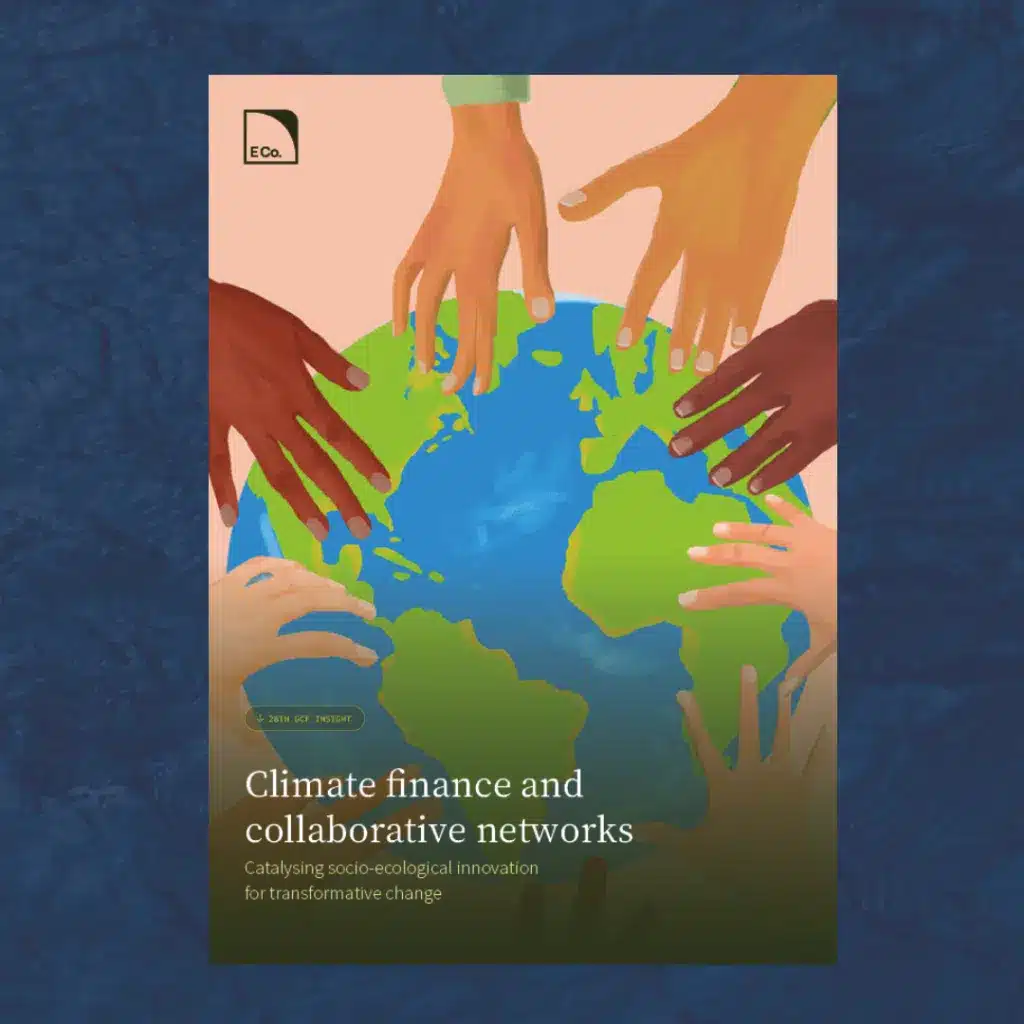
And if you’d like to read our 28th GCF insight report for the full findings from our survey and interviews on ‘Climate finance and collaborative networks: catalysing socio-ecological innovation for transformative change’, you can click on the image below or view it on our report page here:
About E Co.
E Co. is a leading climate finance and development consultancy headquartered in London, based globally. We provide consulting support to access climate finance from the GCF (and other funds and donors) across several service areas, including: market assessment, strategy formulation, policy development, monitoring and evaluation, fund support and training. However, we may be best known for our programme and project design services in response to the Fund’s criteria and processes.