GCF insight #32

Climate change is eroding the very systems people depend on to survive and recover: their health services, their water and sanitation, and the social protection that catches them when shocks arrive. However, the financing response has not matched the need. Only 0.5 per cent of multilateral climate finance has reached health systems (WHO, 2023), and within the GCF, health, WASH and social protection have tended to sit at the margins of a portfolio that favours hard infrastructure.
This 32nd GCF insight examines how climate finance can more deliberately support resilience across this interconnected nexus. It explores how health systems, WASH, and adaptive social protection are currently treated in GCF programming, what the evolving policy environment means for project design, and why a people-centred investment pathway is both justified by the evidence and demanded by the scale of need. It also highlights what inclusion requires in practice for women, Indigenous Peoples, climate migrants and refugees, and communities living in fragile, conflict-affected, and informal settlement contexts.
Drawing on E Co’s consultancy experience, a desk review of GCF policy and the GCF-FAO 2025 joint review, case studies spanning Togo, Vanuatu, Mozambique, and Central and West Asia, and in-depth interviews with practitioners across GCF-accredited entities, Direct Access Entities, and the GCF Secretariat, the report sets out how the Fund can move from ad hoc engagement with these areas toward an integrated, measurable, people-centred strategy.
Blog | Lost in translation at BCIW 2026: Manufacturing bankability in Latin American climate finance

By Felipe Arenas Gallo Inside the air-conditioned halls of SP Hall, blocks away from the financial district of the Avenida Faria Lima, the talk is of momentum and mobilised billions towards deployment of Nature-based Solutions (NbS). The energy is one of contrasts. Less than a year ago, many of those present at Brazil Climate […]
Blog | From diagnosis to transformation: Rebuilding ‘mother nature’ on Armenia’s day of Motherhood

By Aurelio Padovezi (E Co.) and Sona Akopian (EPIU), Ministry of Environment of the Republic of Armenia On the morning of 7 April, Yerevan marked the Day of Motherhood and Beauty. Across the city, the manner in which Armenia commemorates the Day of Motherhood and Beauty moves with intense symbolism, extending beyond mere floral […]
Replay kit | GCF B.44 unpacked
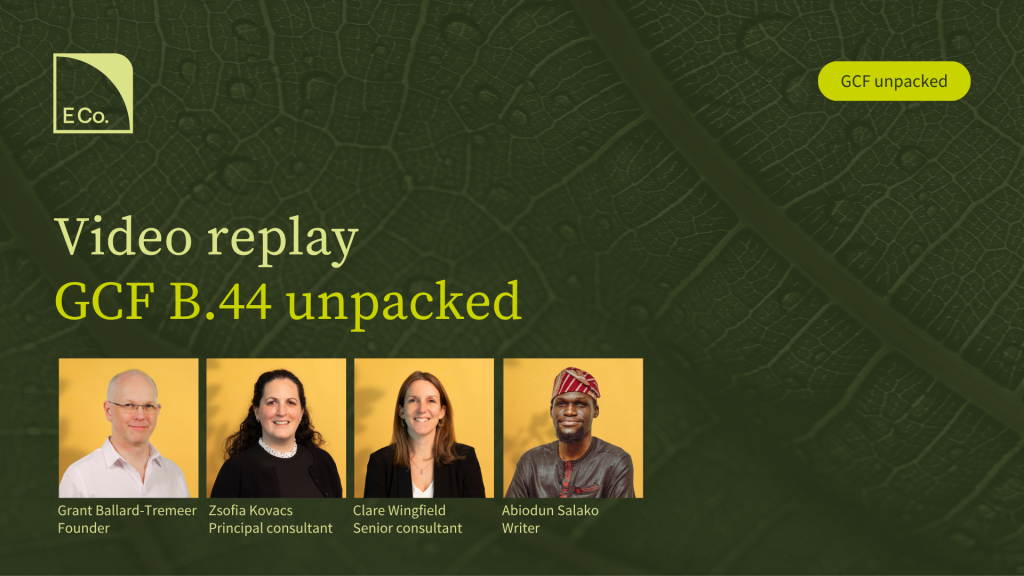
On Tuesday, April 21, 2026, our climate finance experts hosted a debrief session to analyse key developments from the recent 44th Green Climate Fund (GCF) Meeting of the Board (B.44), which took place from March 25 to 28, 2026. They also discussed our recent 31st GCF insight report, focusing on ‘Rethinking capacity building models for […]
Blog | The market came to us: Grant on 26 years at E Co.

On 28 March, E Co. turned 26. It is a milestone worth reflecting on because of what has been built, defended, and proven right over those years. We sat down with our founder, Grant Ballard-Tremeer – who has spent 26 years creating E Co. – for a candid conversation about the long game: what the […]
GCF insight #31

Welcome to your 31st GCF insight report – Rethinking capacity building models for climate finance readiness.
Capacity building sits at the heart of international climate finance. Multilateral funds have long recognised that financial resources alone cannot deliver climate outcomes without competent institutions capable of planning, coordinating, and executing complex investment programmes. Significant investment has been made in training, technical assistance, and readiness support to build that foundation. However, a significant hurdle continues to hold things back: while training is being delivered, the conditions to make it stay and translate to more projects aren’t fully present.
Blog | Operating in flood mode: Nairobi’s race to finance urban resilience

By Isaac Njuguna March 2026, Nairobi. March usually marks the onset of Kenya’s long rainy season, but the rains are progressively arriving with deeply damaging force. Now, one of the biggest cities in Sub-Saharan Africa stands defaced by another heavy downpour, the heaviest since 2024. The picture is a complete eyesore: damaged critical infrastructure, […]
Blog | Scaling energy-efficient cold storage for agricultural resilience

By Abiodun Salako Food is the world’s most essential resource, yet approximately 13.2% of it is lost annually between harvest and retail. According to the Food and Agriculture Organisation (FAO), this loss, totalling over USD 400 billion, occurs during transport, storage, and processing. In developed countries, the conversation often centres on retail and consumer […]
Blog | Carbon sinks & the forestry finance frontier: scaling the world’s most efficient technology

By Abiodun Salako Introduction Global temperatures have climbed around 1.3°C above pre-industrial levels, mainly due to fossil fuel combustion and land-use changes such as deforestation. This warming has unleashed fiercer storms, wildfires, droughts, and other climate extremes. Natural carbon sinks such as forests, soils, and oceans, absorb roughly half of human-caused CO2, slowing warming while […]
Blog | Channeling climate finance into waste-to-energy across Sub-Saharan Africa

By Abiodun Salako The world generates more than 2 billion tonnes of municipal solid waste each year, a figure projected to reach 3.4 billion tonnes by 2050 by the World Bank. While high-income countries produce the most waste per capita, it is low and middle-income countries that bear the greatest burden of mismanagement. Over […]